Why Your Best Growth Programs Look Like They're Failing
The investments that compound are the ones you're most tempted to kill.
I spent a year building a content program that my CEO called “the slow one.” Every board meeting, he’d point to paid campaigns generating leads that week and ask why content wasn’t performing at the same level. Every quarter, I’d show a slightly better graph and make the same pitch: give it time, the curve is building.
At month 6, it cost 3x as much per lead as paid. At month 12, it crossed over. By month 17, it was generating 40% of the pipeline on 15% of the budget — and getting cheaper every month without us spending another dollar.
The same CEO who wanted to kill it started calling it “our moat.”
Here’s what nobody told me early in my career, and what I’ve confirmed over twenty years of building growth programs: the investments that compound are the ones that look worst in their first year. They follow a curve that’s specifically designed to fool you into quitting.
The Compounding Curve
The conventional view of growth investment is linear. Spend a dollar, get some fraction of a result. Spend two dollars, get roughly twice the result. This is how paid acquisition works, and it’s how most executives evaluate growth performance — including the growth leaders themselves.
But the most valuable growth investments don’t work this way. They follow a compounding curve: flat, flat, flat, then steep. Nearly worthless for months, then increasingly valuable for years. The problem is that at the decision point — the moment when a program gets evaluated for continuation or cancellation — compounding programs are indistinguishable from programs that simply aren’t working.
This is where the physics of momentum matters. In physics, momentum is mass times velocity — but the useful insight isn’t the formula. It’s the asymmetry. Building momentum requires sustained force over time against resistance. Once an object has momentum, it requires very little energy to maintain. And stopping it, then restarting from zero, costs more than the original investment because you’ve lost all the accumulated energy.
Growth programs follow the same curve. A brand that’s been building market presence for a year requires almost nothing to maintain its recognition — and each new campaign performs better because it’s drafted behind the authority of everything that came before. A brand that’s reached recognition threshold converts at higher rates across every channel, making every other dollar more efficient. Content from an established authority gets cited by AI systems, shared by peers, and discovered through referrals — each piece amplifying every piece that came before it.
The conventional explanation when a program isn’t showing results at month twelve: it isn’t working. The physics explanation: it hasn’t built enough mass to generate visible momentum yet. These two readings of the same data lead to opposite decisions. One says cut. The other says hold.
The Data Has Gotten More Extreme
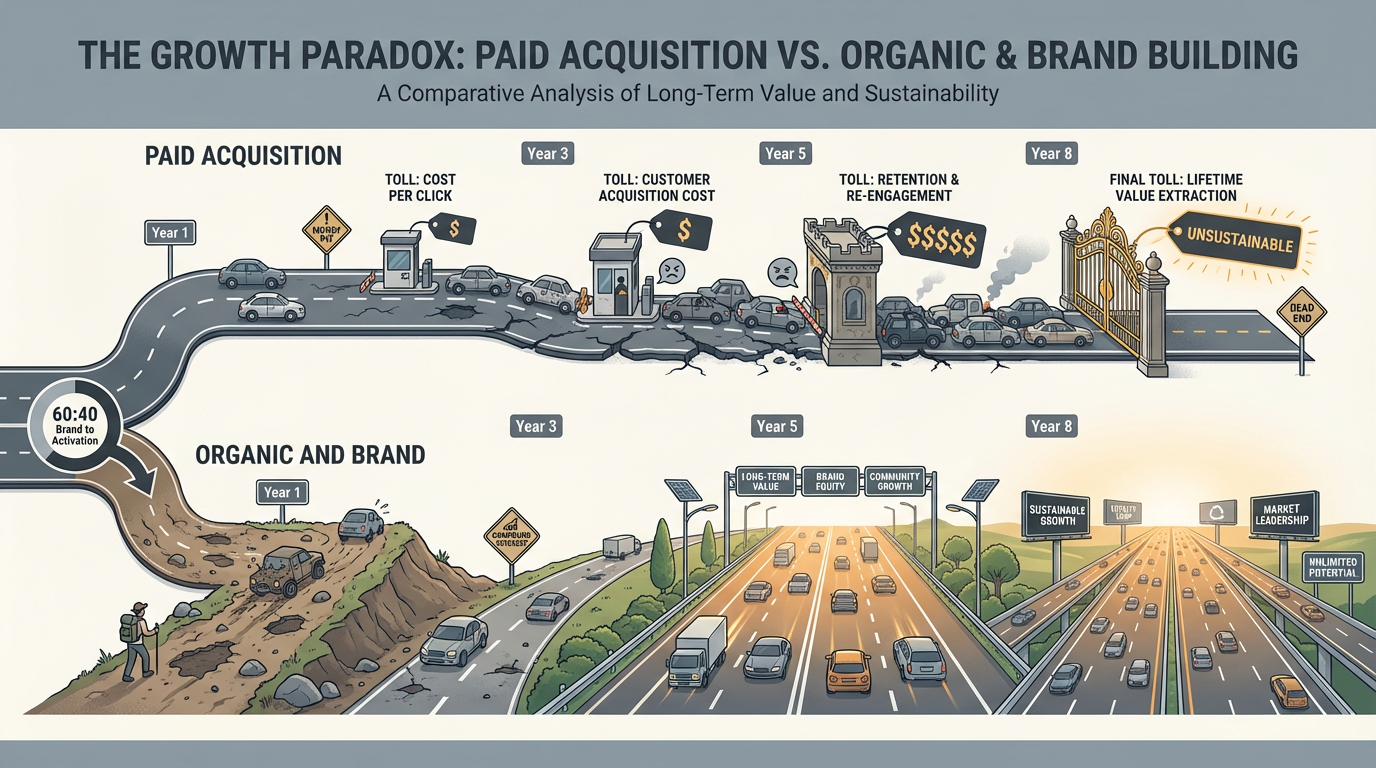
The data on this is striking. And it’s gotten more extreme precisely because the way buyers discover solutions is shifting underneath us.
Les Binet and Peter Field analyzed 996 campaigns across 700 brands through the IPA Databank and quantified the mechanism. Brand-building campaigns — the compounding kind — are less efficient than activation campaigns in the short term. But their efficiency grows over time. Activation campaigns show the inverse: efficient immediately, declining after a few months. Their recommended allocation is 60% brand (compounding) to 40% activation (transactional). Most B2B SaaS companies invert this ratio because short-term activation is the only thing that shows results in a quarterly review. Meanwhile, the acquisition economics keep diverging — First Page Sage’s 2026 benchmarks put B2B organic CAC at $942 versus $1,907 for paid, and paid costs have inflated 222% over eight years while organic CAC falls as authority builds.
Now, here’s where it gets interesting for anyone watching their organic traffic decline: traditional discovery channels are compressing. Seer Interactive’s 2025 study of 3,119 queries across 42 organizations found organic click-through rates dropped 61% for queries where Google’s AI Overviews appear. Over 60% of Google searches now end without a click. AI-generated summaries from ChatGPT, Perplexity, and Google itself are answering questions that used to send traffic to your site.
If you read that and think compounding investment is dead, you’re making the same linear-thinking mistake this post is about.
What’s actually happening is that accumulated brand mass — the compounding asset — is becoming more important, not less. Seer Interactive’s analysis of 500+ AI citations found that brand search volume is the strongest predictor of whether an AI system cites you. Brands that get cited in Google’s AI Overviews see 35% higher organic click-through rates than brands that don’t. The gap between cited and invisible isn’t small. It’s the difference between compounding in the new channel and disappearing from it entirely.
The compounding dynamic didn’t break. The measurement changed. Instead of ranking on page one, the question is whether AI considers you authoritative enough to cite. And what determines that? The same accumulated mass that drove compounding before: domain authority, content depth, brand recognition, and the kind of consistent investment that takes a year to pay off and then pays off for years. An AirOps study found that 95% of ChatGPT citations come from content published or updated within the last ten months. Freshness matters — but only if you’ve already built the authority that gets you into the citation set at all.
The cost of interruption makes this worse. The Ehrenberg-Bass Institute found that brands that stop investing see sales decline 16% in year one, 25% by year two, and 36% by year three. Their research shows recovery takes disproportionately longer than the hiatus — a one-year pause requires more than a year of renewed spend just to reclaim lost ground. In a world where AI systems preferentially cite established authorities, the penalty for going dark is even steeper — you don’t just lose momentum, you lose the citation position that compounds into future visibility.
Why Smart Leaders Keep Making the Same Mistake
So why do smart leaders keep making the same mistake?
Because the compounding curve has a specific, predictable failure mode built into it — and it maps perfectly to how companies make decisions.
In the first six months of any compounding program, you’re generating cost with almost no visible return. You’re publishing content nobody discovers, building authority that neither search engines nor AI systems have recognized, creating brand impressions that haven’t reached frequency threshold. The program is working — mass is accumulating — but there’s nothing to show for it on a dashboard.
From months six through twelve, early signal appears. Some traffic, some leads, maybe a few attributable opportunities. Brand search volume ticks up slightly. An AI tool cites you for the first time on an obscure query. But the numbers are modest, and on a per-dollar basis, the program looks terrible compared to paid channels that produce immediate results. This is the most dangerous period. There’s just enough data to evaluate — and not enough to show compounding. A quarterly review at this point will surface a program that costs more per lead than alternatives and has “no clear path to scale.”
After month twelve, if the program has been funded consistently, compounding begins to emerge. Cost per lead starts declining. Content generates leads on its own. AI systems start citing you on higher-value queries because you’ve crossed the authority threshold. The curve inflects. Each additional dollar produces more than the last.
The problem: standard planning cycles — quarterly business reviews, annual budgets, leadership transitions — are tuned to evaluate programs right in that six-to-twelve-month danger zone. The evaluation window is perfectly calibrated to kill compounding programs before they compound.
This isn’t a metaphor. It’s a measurement problem. The systems companies use to assess growth performance are structurally biased against the investments that produce the highest long-term returns. If you evaluate compounding programs on the same timeline and with the same metrics as transactional ones, compounding will always lose — until the day it dominates, at which point you’ll wonder why you don’t have more of it.
I saw this play out with a webinar program I ran for a year. Attendance grew. Lead volume grew. Pipeline grew. It looked like compounding. Then I ran the numbers and realized attendance was growing because we were spending more on promotion each quarter. Strip out the increasing spend, and per-dollar performance was flat. That wasn’t momentum — that was linear growth in costume. Real compounding shows up as improving returns on consistent investment, not improving results on increasing investment.
Mass, Velocity, and the Sequence That Matters
The physics framework gives us a way to distinguish real momentum from expensive motion — and to understand why the sequence of investments matters as much as the investments themselves.
Mass is your accumulated market presence — brand recognition, content library, customer base, word of mouth, the breadth of third-party mentions that AI systems use to decide whether you’re authoritative. Mass is slow to build and slow to decay. It’s the reason a mediocre campaign from a well-known brand outperforms a brilliant campaign from a brand nobody recognizes — and the reason AI systems cite established brands preferentially. Mass doesn’t make noise. It bends gravity.
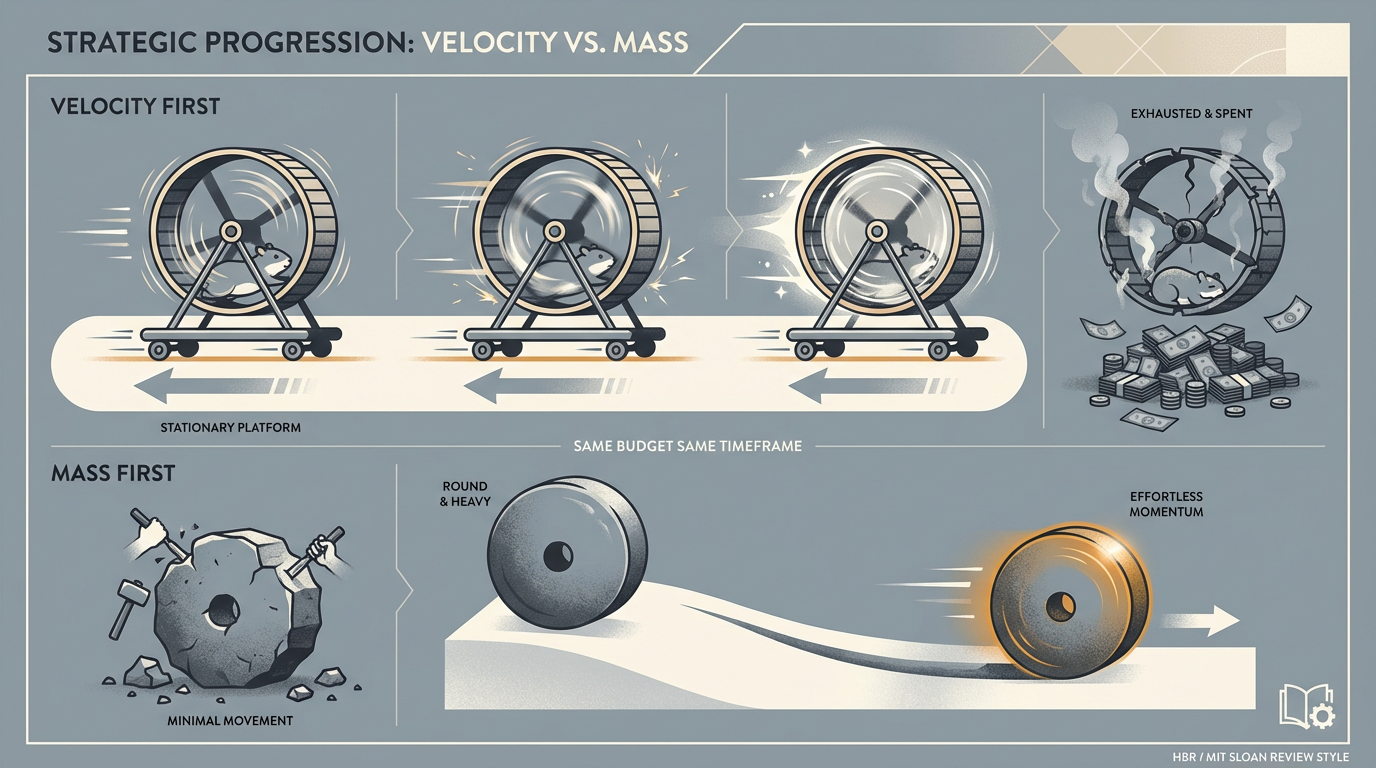
Velocity is what most growth teams optimize for: campaign performance, conversion rates, pipeline speed, launch cadence. Velocity is visible, measurable, and satisfying to improve. It’s also fragile. A campaign ends. A channel saturates. A quarter resets. Velocity without mass is activity that doesn’t accumulate into anything durable.
The counterintuitive part is the sequence. Mass must come first. You need accumulated market presence before velocity produces compounding returns. A startup running aggressive paid campaigns at high velocity but with no brand mass isn’t building momentum. They’re renting attention at an escalating price. Each dollar spent produces roughly the same return as the last — or worse, as auction dynamics drive costs up. That’s linear growth. That’s a treadmill.
Compounding happens when velocity acts on existing mass. Content published by a site with established authority ranks faster — and gets cited by AI systems. Campaigns from a recognized brand convert at higher rates across every channel. Each new touchpoint reinforces every previous touchpoint. The return on dollar 1,000 is genuinely higher than the return on dollar 1. That’s the flywheel — and it works regardless of whether discovery happens through a Google search, an AI-generated answer, or a colleague forwarding your newsletter.
This dynamic changes at different stages. At Series A, you have almost no mass. Applying force — campaigns, spend, outbound — to a light object produces erratic, unpredictable results. You’re building mass, full stop. At Series B, real presence emerges and programs can start compounding because there’s enough mass to generate consistent velocity. At Series C and beyond, mass becomes the dominant force — the weight of the brand carries campaigns further on less spend.
The mistake at early stages is expecting momentum when you should be building mass. The mistake at later stages is treating compounding investments the same as transactional ones in planning and evaluation. A paid campaign’s job is to generate pipeline this quarter. A content program’s job is to make every future quarter progressively cheaper. Evaluating both on quarterly pipeline contribution guarantees you’ll underfund the one that matters most for long-term economics.
What to Do About It
If you’re a founder or board member, the move is structural. Build the evaluation framework that lets compounding programs survive their first year. That means tracking cost per lead trend over time, not point-in-time comparison to paid. Track brand search volume growth as a leading indicator — it’s now the strongest predictor of whether AI systems cite your brand, making it the closest thing you have to a forward-looking metric for discovery in the AI era. Define success at month twelve as “cost per lead declining quarter over quarter,” not “cost per lead competitive with paid.” The programs worth protecting are the ones whose economics improve with time — even if the starting economics look terrible.
If you’re a growth leader, the move is making the invisible visible. The reason compounding programs get killed is that their value is structural and hard to see on a dashboard. A paid campaign shows a direct line from spend to leads. A brand program builds authority that shows up as AI citations, branded search volume, and improving conversion rates across every other channel — none of which appear in the campaign report. You need to show the compounding curve explicitly — cost per lead at month three, month six, month nine, month twelve, plus brand search volume trend and AI citation frequency — before someone questions the spend. The trendline is your argument. Not the snapshot.
The math is unambiguous. Brand-driven channels produce acquisition costs at half those of paid, and the cost trends move in opposite directions. In a world where AI systems preferentially cite authoritative brands, the compounding advantage of accumulated mass is accelerating, not shrinking. Every month you keep a compounding program funded is a month its economics improve. Every month you pause it is a month you’ll eventually pay five times over to rebuild.
That content program I almost lost at month six? By year two, it was the single largest source of qualified pipeline in the company. Cost per lead had dropped 80% from its first-year average. The paid campaigns we’d considered redirecting budget toward had gotten 30% more expensive over the same period.
The counterintuitive truth about growth momentum: the programs most worth protecting are the ones that look least worth protecting. The flat part of the curve isn’t evidence of failure. It’s the price of the inflection that follows.
The only thing more expensive than building momentum is building it twice.
Nick Talbert is a growth and GTM executive with 20+ years of experience leading growth at B2B SaaS and technology companies, including roles at companies later acquired by Amazon and AOL. He writes about go-to-market strategy at strategnik.com.
Nick Talbert builds growth infrastructure for technical products. 20+ years in B2B SaaS, adtech, and enterprise technology. LinkedIn | nick@strategnik.com